It’s February. It’s minus 25 with the windchill, your apartment doesn’t have a balcony, and the closest place you’re allowed to vape is out the front doors. That means boots, jacket, elevator, lobby, and a polite nod to the neighbour who always wants to chat about the weather. Which, to be fair, is terrible.
If you switched from cigarettes to vaping, there’s a good chance you’ve stood by the door in your socks and asked yourself: can my landlord actually tell if I vape inside?
It’s a fair question. Vaping doesn’t burn anything, so it doesn’t leave the same heavy smell cigarettes do. But different isn’t the same as invisible.
In this guide we’ll go through what can actually give indoor vaping away: smell, residue on glass and walls, smoke alarms, vape detectors and neighbours. Then we’ll get into the part that matters most, which is what your lease and your province say. I’ll add quick links below so you can jump around.
Quick Links (If you don’t want to read)
- Can my landlord actually tell?
- Does vaping leave a smell?
- Do air purifiers help?
- Does vaping leave residue on windows and walls?
- Smoke alarms and vape detectors
- Can your landlord ban vaping in Canada?
- No balcony, or living with roommates
- Frequently asked questions
Can my landlord actually tell if I’ve been vaping inside?
Short answer: sometimes, yes. Not always, and not with the certainty that some detector companies would like you to believe.
A landlord might notice a few different things. The catch is that most of them are signs, not proof. A sweet smell in the hallway could be your mango ice, or it could be someone’s candle. A hazy window could be vape residue, or it could be a winter’s worth of cooking steam and a cheap glass cleaner.
Here’s what can tip someone off, and how much each one actually tells them:
| Sign | What it may tell them, and its limits |
|---|---|
Sweet or fruity smell | Flavoured aerosol may have been in the air. Limit: candles, air fresheners and baking can smell very similar. |
Film on windows or mirrors | Deposits may have built up over time. Limit: humidity, cooking and household cleaners leave films too. |
Neighbour or roommate complaint | Someone noticed a smell or a cloud. Limit: a complaint on its own doesn’t show where it came from. |
Smoke alarm going off | Enough aerosol may have reached the detector. Limit: steam, burnt toast and dust can do the same. |
Dedicated vape sensor | The device picked up air changes linked to vaping. Limit: accuracy depends on the device, and most apartments don’t have one. |
Unit inspection | A landlord entering with proper notice may notice any of the above. Limit: they’re still looking at signs, not a recording. |
So yes, indoor vaping can be noticed. But noticing something and proving it are two different things. And as we’ll get to, whether they can tell and whether you’re allowed are two separate questions too.
Does vaping leave a smell in your apartment?
Not the way cigarettes do. Cigarette smoke comes from burning tobacco, and it leaves that stale smell that gets into curtains, couches and clothes. Vaping heats a liquid instead, so there’s no smoke and no ashtray smell.
Odourless? Not quite. Flavours are designed to smell like something, so if you blow out a cloud of strawberry ice, the room will smell a bit like strawberry ice for a while. But it’s a light, sweet smell that fades fast, and it’s nowhere near as noticeable as a burning cigarette.
How long does vape smell last?
Usually not long. Room size, airflow and what you’re vaping all play a part, but vape smell tends to dissipate quickly, often faster than people expect. One quick puff in a big room is very different from a whole evening in a closed bedroom with a custard flavour, though. Anyone who promises it’s gone in exactly ten minutes is guessing.
Can neighbours or roommates smell vaping?
If they’re in the same room as you, yes, they can probably smell it. But the smell usually dissipates quickly and doesn’t travel far. A neighbour down the hall or on the other side of a wall is very unlikely to pick up much.
It wasn’t always like that. About ten years ago, custom mods and rebuildable droppers were all the rage, and plenty of us were vaping at 200 watts or more and exhaling clouds that could pass for a fog machine at a bad concert. Back then, sure, the smell was stronger because of the sheer amount of vapour in the room. These days, with modern disposables and pod vapes, it’s nowhere near as noticeable.
What about THC vapes?
That’s a different story. THC vapes tend to produce more smell, and it’s a very specific one. It’s earthy and a bit skunky from the plant’s terpenes, which is nothing like vape juice, and a flavoured THC pen can still smell like cannabis underneath the flavour. If that’s what you use, treat it as its own case. Your lease or building rules on cannabis can be different from the ones for nicotine, so check them separately.
Do air purifiers help with vape smell?
An air purifier is honestly one of the best investments you can make for the air in your home, vaping or not. It helps with dust, pollen and pet dander, and it can take the edge off lingering smells too. A few things to know before you buy one:
- HEPA filters catch particles, including fine ones like PM2.5. On their own they don’t remove gases or odours.
- For smell, look for real activated carbon. The EPA notes that a thin carbon layer only helps for a short time, so a unit with a good amount of carbon is what you want.
- Match it to your room. Check the CADR rating, which tells you how quickly it cleans the air. For a standard 8 foot ceiling, the EPA suggests a CADR of roughly 65 for a 100 sq ft room, 130 for 200 sq ft and 195 for 300 sq ft.
- Skip anything that makes ozone. You want cleaner air, not a new pollutant.
To keep expectations honest: no air cleaner removes everything, and the EPA’s guide to air cleaners says they work best alongside ventilation and keeping pollution out at the source. It also says studies on HEPA purifiers show small health improvements at best, often not noticeable. Think of a purifier as a solid upgrade for your air, not a magic eraser.
Does vaping leave residue on windows, glass and walls?
This is the part people get wrong in both directions. Some forums say vaping leaves no trace at all. Some property sites make it sound like one pod will ruin your drywall. The truth sits in the middle.
Why can vaping leave residue?
Most vape liquids are made mainly of vegetable glycerin (VG) and propylene glycol (PG), plus flavouring and, usually, nicotine. When the liquid heats up, it turns into an aerosol of tiny droplets. That’s the cloud you see.
The visible cloud disappears quickly. But some of what’s in it can settle onto nearby surfaces before it’s fully gone.
Why do windows and mirrors sometimes get a film?
Glass shows everything. A streak or haze that you’d never notice on a painted wall is obvious on a window with the sun behind it. Regular indoor vaping can add to deposits on windows, mirrors and other surfaces.
That said, a cloudy window isn’t automatically vape residue. Condensation, humidity, cooking, dust and leftover cleaning product can all leave a similar film, especially in a Canadian winter when the windows are closed for months.
What does the research say? In a 2019 study in the Journal of Occupational and Environmental Hygiene, researchers exposed glass and cotton terrycloth to vape aerosol for an hour and then tracked the nicotine on them. Nicotine settled on both surfaces and was still measurable 72 hours later. Their model estimated it would take around 4 days to drop back to background levels on glass, and around 16 days on the cloth.
In plain English: nicotine from vape aerosol can stick around after the cloud is gone. What that study did not show is that every greasy film on a window comes from vaping. It measured nicotine in a controlled test, not visible gunk in real apartments. That’s an important difference.
Is vape residue the same as cigarette staining?
No, and cigarette residue is much worse. The yellow-brown staining people associate with long-time smokers’ apartments comes from smoke produced by burning tobacco. Vape aerosol is a different thing.
A small 2015 pilot study wiped surfaces in 6 smokers’ homes, 8 vapers’ homes and 8 homes where nobody used nicotine. Average surface nicotine in the vapers’ homes was far lower than in the smokers’ homes, and not statistically different from the non-users’ homes. It’s a tiny sample from one study, though, so treat it as an interesting early result rather than the final word.
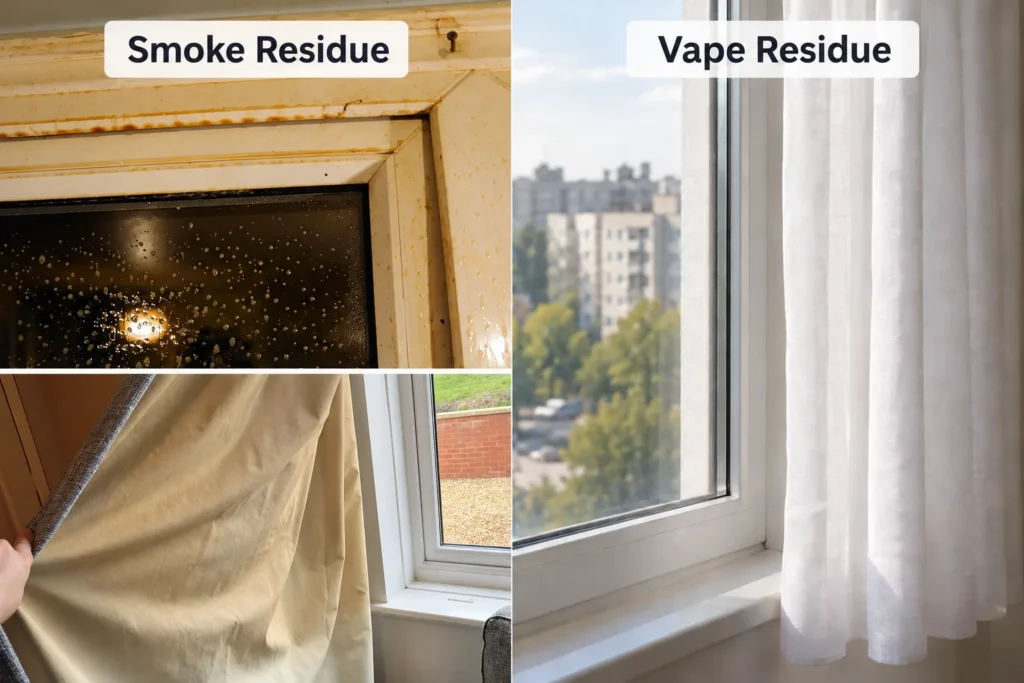
Smoke vs vape residue on windows and curtains
Tobacco smoke doesn’t just sit on the glass. Researchers who study thirdhand smoke have found that the residue clings to walls, furniture, carpets and curtains, and that porous things like fabric hold on to it and release it slowly. That’s why a smoker’s curtains can keep smelling long after the windows have been open, and why airing a room out doesn’t fully fix it.
Vape aerosol is mostly VG, PG and flavouring, and it doesn’t leave that sticky, yellow-brown tar behind. You can still get a light film on glass over time, and curtains will pick up whatever is floating around the room, but it’s a wipeable haze and a wash cycle, not a smell that moves in for years.
Candles are the worst offenders
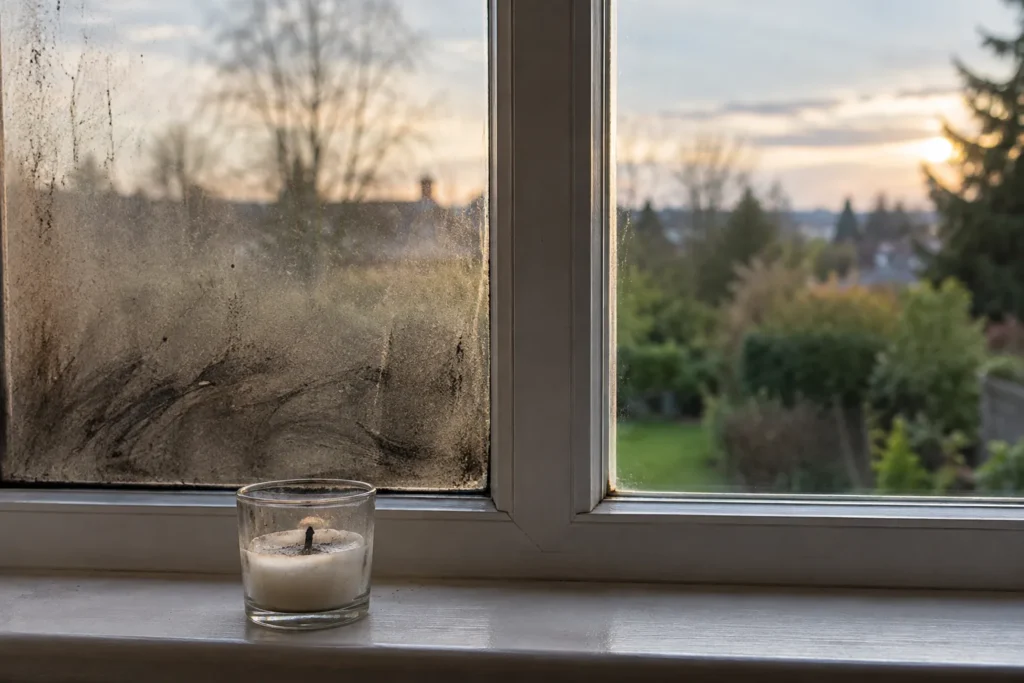
Plenty of the haze on indoor glass has nothing to do with vaping. Studies of candle emissions found that a sooting flame gives off mostly black carbon particles, and that a candle that has just been blown out keeps smouldering and releases a white smoke of organic particles. Earlier research has linked candle soot to black marks on walls and soiled artwork.
One 1999 study in Environmental Science & Technology compared candle types and found that smouldering beeswax candles gave off more particles than paraffin ones in that test. That study measured particles in the air, not how badly glass gets stained, so I can’t tell you beeswax is worse for your windows. What I can say is that if a landlord points at a film on the glass, candles are a prime suspect.
How do you clean vape residue off windows?
For an ordinary film on glass, a regular glass cleaner or a bit of dish soap in warm water does the job. Wipe with a microfibre cloth, then buff it dry with a second one. For walls, start gentle and test a hidden spot first, because some paints don’t love being scrubbed.
If you’re dealing with something beyond a normal film, like actual staining or damage, that’s a different conversation, and it’s one to have with your landlord.
Can smoke alarms or vape detectors detect vaping?
A lot of people assume no fire means no alarm. Not quite.
Can vaping set off a regular smoke alarm?
It can. Some smoke alarms react to enough aerosol in the air, especially a big cloud right underneath one. It depends on the type of detector, how close you are and how dense the cloud is. If you’ve ever set one off with a steamy shower or burnt toast, it’s the same idea.
Worth knowing: fire alarms in condos and apartment buildings go off falsely all the time, from shower steam, cooking or dust, with no fire, no smoke and no vape involved. So an alarm going off isn’t proof of anything on its own.
Are vape detectors real?
Yes. Dedicated sensors exist that watch for air-quality changes linked to vaping. Manufacturers describe them as using laser particle sensors, and some add chemical sensors for things like nicotine or THC. You’ll find them in some bathrooms, schools, hotels and managed buildings. They’re rare in regular apartments, but if you’re curious, a quick look at the ceiling or a question to your landlord will tell you.
A regular smoke detector is built to spot combustion smoke, using ionization or photoelectric sensors. A vape detector is built to pick up aerosol and sometimes specific chemicals. They’re different devices doing different jobs.
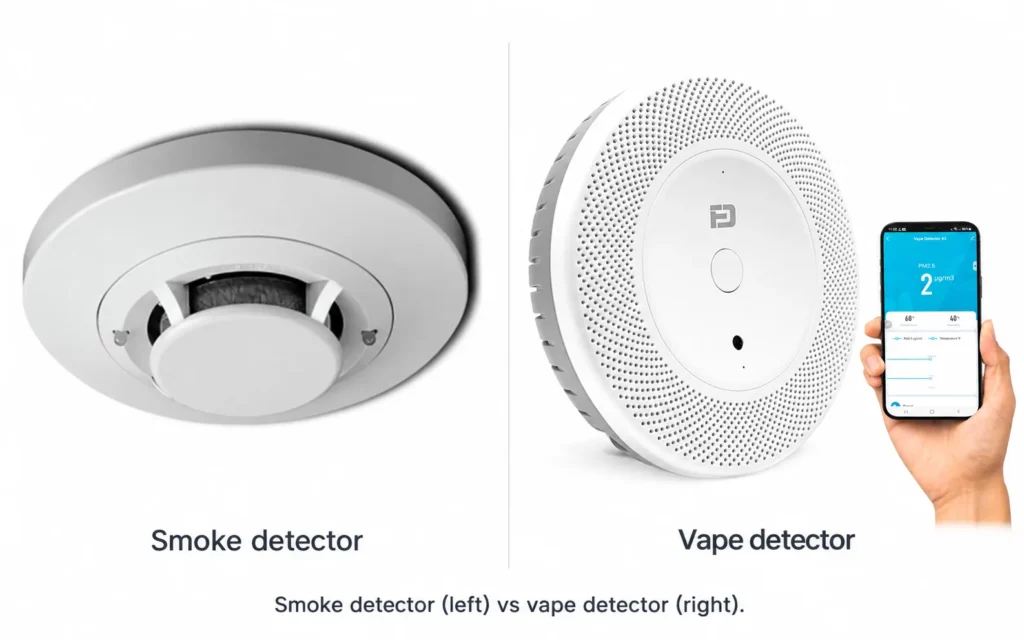
| Smoke detector | Vape detector | |
|---|---|---|
What it senses | Combustion smoke, using ionization or photoelectric sensors | Aerosol particles, using laser sensors, and sometimes chemicals like nicotine or THC |
Where you’ll find it | Units and hallways in most apartment buildings | Some bathrooms, school washrooms, hotels and managed buildings |
Common false triggers | Steam, cooking and dust | Depends on the model, and some may react to aerosol sprays |
Can it say who vaped? | No | No, it only logs that something changed in the air |
Can a detector prove who was vaping?
Not on its own. And honestly, you’re very unlikely to run into one at home, because vape detectors are rare in regular apartments. They mostly show up in schools, hotels and some managed buildings. If your unit does have one, an alert only says something changed in the air at a certain time. It doesn’t name anyone, and whether it supports a lease complaint depends on your lease, your province and everything else going on.
One thing that isn’t up for debate: leave smoke alarms alone. They’re a safety device for actual fires, and covering or disabling one is a serious problem in any rental.
Can your landlord ban vaping inside your apartment in Canada?
Here’s the part that matters more than anything about smells or sensors. Whether your landlord can tell and whether you’re allowed to are two different questions. Even if nobody ever noticed, a no-vaping clause in your lease still applies.
Can you vape inside a rental apartment in Ontario?
According to the Ontario government, you’re generally allowed to smoke or vape in your own home, unless your lease, agreement or condo bylaws say otherwise. Vaping is banned in common indoor areas of apartment and condo buildings, like hallways, elevators, stairwells, lobbies, laundry rooms, parking garages and party rooms.
If smoke or vapour from one unit interferes with another tenant’s reasonable enjoyment of their home, that can become a matter for the Landlord and Tenant Board. Under the Residential Tenancies Act, a landlord can also apply to evict a tenant whose smoking or vaping seriously impairs safety or interferes with other tenants’ reasonable enjoyment. The Board decides each case on its own facts.
What about other provinces?
Rules vary by province and sometimes by city. In British Columbia, landlords can make a unit vape-free, but it has to be written into the tenancy agreement. In multi-unit buildings, BC also says you can’t smoke or vape within 6 metres of doors, open windows or air intakes connected to common areas.
| Province | What to know |
|---|---|
Ontario | Vaping in your own unit is generally allowed unless your lease, agreement or condo bylaws say otherwise. Never in common indoor areas. |
British Columbia | Landlords can ban vaping, but only through the tenancy agreement. Stay 6 metres from doors, open windows and air intakes connected to common areas. |
Other provinces | Rules differ. Your lease and your provincial tenancy office are the places to check. |
Last checked October 2026. This is general information, not legal advice.
Can you be evicted for vaping?
Generally, no, not just because someone suspects it. To get anywhere, a landlord would need a lease that clearly prohibits vaping and real proof that you were actually vaping.
And proof is the hard part. As we covered, vape smell fades fast, doesn’t travel far and is easy to confuse with candles, cooking or air fresheners. Realistically, the only airtight proof would be video of you vaping inside, and landlords generally aren’t allowed to put cameras inside the unit you rent. Rules differ by province, so check yours.
I’m not a lawyer, so if you’re in an actual dispute, your provincial landlord and tenant board or tenancy branch is the place to go.
| Done | Before you vape at home |
|---|---|
| ✓ | Read your lease and search it for the words smoking and vaping. |
| ✓ | Check your condo bylaws if you rent in a condo building. |
| ✓ | Ask your landlord in writing if the lease isn’t clear, so you have the answer on record. |
| ✓ | Check whether your unit has a vape detector or special alarm. Look for sensors on the ceiling, or just ask your landlord. |
| ✓ | Check your province’s tenancy rules since they’re not the same everywhere. |
What if you don’t have a balcony or live with roommates?
I get it. Bundling up, waiting for the elevator, standing outside at minus 25 for a few puffs, then doing it all again in reverse. If you used to smoke, you know the drill, and it doesn’t get more fun in January.
No balcony usually means a walk through the building every time. Roommates add another layer. You might be completely fine with vaping indoors while the person you share a kitchen with isn’t, and shared air means they get a say. Ventilation moves air around a building, but it doesn’t keep everyone else out of it.
Health Canada notes that bystanders can be exposed to the aerosol people exhale when they vape, and it recommends vaping outdoors only and being careful about vaping around others.
So the cold is real and annoying. But your building’s rules and the people you live with come first.
Frequently asked questions
Does a no-smoking clause in my lease include vaping?
It depends on the wording. Some leases say “smoking” only, and others name vaping or e-cigarettes outright. If it’s unclear, ask your landlord in writing and keep the answer. Don’t assume it’s fine just because the word vaping isn’t there.
Do I have to tell my landlord that I vape?
Usually there’s no rule that says you must bring it up on your own. What counts is your lease. If it bans vaping indoors, vaping anyway is a breach whether or not you ever mentioned it. If a rental application asks you directly, answer honestly.
Can my landlord come into my unit to check for vaping?
Not whenever they feel like it. In most provinces a landlord needs a valid reason and has to give written notice first. In BC, for example, the province says the notice has to be given at least 24 hours ahead, state the date, time and reason, and entry has to be between 8 a.m. and 9 p.m. There are exceptions, like emergencies. Other provinces have their own rules, so check with your provincial tenancy office.
Can my landlord tell if I vape in the bathroom?
Very unlikely. Bathrooms already have plenty of strong smells going on, like soap, perfume, lotion, hairspray and air freshener, and those usually smell far stronger than a quick vape. Bathroom fans can connect to shared exhaust, but vape smell just blends in with everything else in there.
Can I vape on my balcony if my building is vape-free?
Check your lease or condo bylaws, because some buildings cover balconies and patios too. Even where they don’t, smoke and vapour drifting into a neighbour’s window can still cause a complaint, and BC has its own distance rules for doors, windows and air intakes.
Can a landlord charge me for vaping-related damage?
Real damage from vaping is very unlikely, and a normal film you can wipe off isn’t damage. What counts depends on your lease and your province’s rules, but a landlord would need to show actual damage, not just a suspicion. Actual staining or ruined finishes would be a different conversation.
So, can your landlord really tell?
Sometimes. Indoor vaping isn’t undetectable, but it isn’t the same as smoking cigarettes either, and the smell fades fast and doesn’t travel far. A smell, a film on the glass, a neighbour’s complaint or a sensor can make it noticeable, and none of those is automatic proof.
The bigger question is what your lease and your province allow. Read your lease, know your building’s rules, and think about the people sharing your air. Canadian winters are rough, but they’re a lot easier when you’re not also fighting with your landlord.
Hopefully this guide cleared things up. One last habit worth having: open a window now and then to air the place out and circulate stale air, which is good practice anyway, and think about an air purifier if you don’t have one. And if a trip is next on your list, here’s how flying with your vape works. Stay warm out there.